BRIOCHE–PASQUIER | Digitalizacja procesu przemysłowego
Brioche–Pasquier tworzy cyfrowe odpowiedniki swoich zakładów wraz ze znajdującym się w nich wyposażeniem, danymi skanowania, planami linii produkcyjnych i modelami budynków.
“Our goal is to innovate in order to create a technological obstacle for our competitors in each market. Designing internally means we can have just as much control over the design, commissioning, maintenance, and operator integration.”
— Freddy Papin Methods and Projects Coordinator, Brioche Pasquier
Brioche Pasquier
Autodesk Customer Testimonial Brioche Pasquier
COMPANY
www.pasquier.fr
LOCATION France, Spain, United Kingdom, United States
SOFTWARE Autodesk® Product Design & Manufacturing Collection Autodesk® Factory Design Utilities Autodesk® Inventor Autodesk® Navisworks Autodesk® Recap Autodesk® Vault Autodesk® Revit
Digitalizing their industrial process: How Brioche Pasquier replicates its fantastic recipes all over the world With 18 factories around the world, including 14 in France, this family company has designated each factory the expert industrial center for one particular activity. The decentralized chain of skills and knowledge is held together through shared decision-making tools.
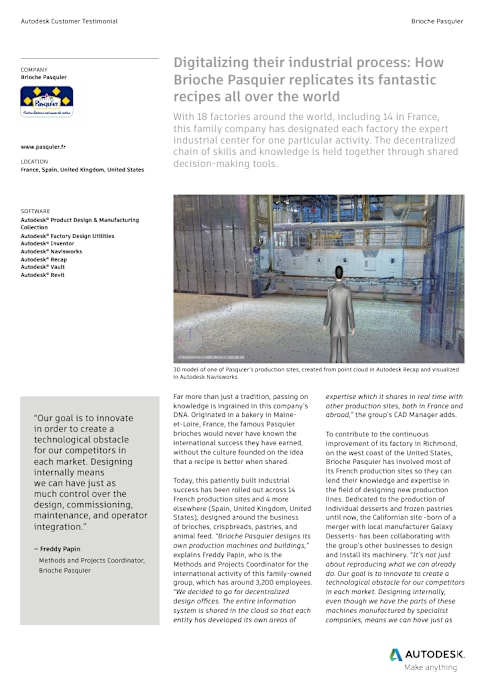
3D model of one of Pasquier’s production sites, created from point cloud in Autodesk Recap and visualized in Autodesk Navisworks
Far more than just a tradition, passing on knowledge is ingrained in this company’s DNA. Originated in a bakery in Maine- et-Loire, France, the famous Pasquier brioches would never have known the international success they have earned, without the culture founded on the idea that a recipe is better when shared.
Today, this patiently built industrial success has been rolled out across 14 French production sites and 4 more elsewhere (Spain, United Kingdom, United States), designed around the business of brioches, crispbreads, pastries, and animal feed. “Brioche Pasquier designs its own production machines and buildings,” explains Freddy Papin, who is the Methods and Projects Coordinator for the international activity of this family-owned group, which has around 3,200 employees. “We decided to go for decentralized design offices. The entire information system is shared in the cloud so that each entity has developed its own areas of
expertise which it shares in real time with other production sites, both in France and abroad,” the group’s CAD Manager adds.
To contribute to the continuous improvement of its factory in Richmond, on the west coast of the United States, Brioche Pasquier has involved most of its French production sites so they can lend their knowledge and expertise in the field of designing new production lines. Dedicated to the production of individual desserts and frozen pastries until now, the Californian site -born of a merger with local manufacturer Galaxy Desserts- has been collaborating with the group’s other businesses to design and install its machinery. “It’s not just about reproducing what we can already do. Our goal is to innovate to create a technological obstacle for our competitors in each market. Designing internally, even though we have the parts of these machines manufactured by specialist companies, means we can have just as
www.pasquier.fr
Images: with the kind permission of Brioches Pasquier. Autodesk, Autodesk Product Design & Manufacturing Collection, Autodesk Factory Design Utilities, Autodesk Inventor, Autodesk, Navisworks, Autodesk Recap and Autodesk Vault are registered trademarks of Autodesk, Inc., and/or its subsidiaries and/or affiliated companies, in the United States and/or in other countries. All other brand names, product names or trademarks belong to their respective owners. Autodesk reserves the right to change its offering of products and services, its product specifications and its prices at any time, without advance notice, and cannot be held liable for any typographical or graphical errors which may appear in this document. © 2019 Autodesk, Inc. All rights reserved.
3D model of production line in Autodesk Inventor showing Pasquier’s automated packing area.
much control over the design, commissioning, maintenance, and operator integration,” says Freddy Papin.
To achieve these results, Brioche Pasquier uses the Autodesk Product Design & Manufacturing collection, supported by its Autodesk reseller Arkance Systems in the commissioning phase of the project. For collaborating, the preferred software is Vault, an organization, management, and data monitoring tool. It is a valuable solution for simulation and technical documentation which supports teams by helping with decision making. “This solution is paired with Inventor, which we use for the 3D design of our machines and their installation,” adds Papin. AutoCAD, Navisworks and Recap, “which allows us to scan our existing sites in 3D to integrate their data into the digital model,” plus Factory Design Utilities and Revit complete the collection for factory layouts, as well as the creation of the factories’ digital twin as a building, thereby integrating the models into the BIM process. “we use all the software applications in this collection of solutions. Even so, it is important to us that Autodesk’s file formats are compatible with the formats used by other publishers that our partners may use.” In the interest of positioning its production sites as close as possible to its customers, Brioche Pasquier operates industrial units distributed far from one another. This creates certain requirements, such as having a specialist technical department in every factory.
In fact, because the production tools have been developed collaboratively, with the support of a lead factory, Brioche Pasquier has drawn up a chain of responsibility known as FILE. “This tool is used for materials management, human resources, and the purchase of raw materials,” says an employee based at the heart of the group, which still has its head office where it was founded in Maine-et-Loire, France. “This means we can cultivate skills with coworkers who are highly specialized in their field so they can bring their expertise to other production sites.” This means that at each of Brioche Pasquier’s factories, there is at least one specialist team that can respond to any industrial or managerial issues arising at one of the
group’s other 18 units. Taking full advantage of these decentralized skills has allowed them to optimize their expenditure on installation, maintenance, and business travel: “We have been able to reduce the number and length of our business trips, particularly those made to the United States.”
As well as the digitalization of factories, Brioche Pasquier’s software choices allow them to simulate a virtual factory so non- technicians or people who are less familiar with reading 2D plans can easily see the future facilities as imagined by their designers. “This 3D experimentation is something that we don’t want to become passive for its users,” says another of the bakery group’s employees. In addition to the 3D animations, Brioche Pasquier now wants to deploy an active experience in which the digital tools—which were initially implemented purely to serve the needs of industrial planning—will be used to train technicians on their work tools. “This is not science fiction,” Papin says. He thinks it is reasonable to envisage that staff will be provided with these digital capabilities “within five years.”
3D visualization of tool stations for Galaxy Desserts site in California with data managed in Autodesk Vault